EU AI Act Readiness Report.
What we found screening 50 European AI companies against the 6 regulatory gates of the EU AI Act. 4 months before Annex III becomes applicable.
Kept as published
Published April 2026, and not updated since. This report describes work carried out under the method in force at that date, and uses the vocabulary of that period. It is stamped, not maintained: a proof of existence at a date is worth nothing once the text it covers has been rewritten. What the service does today is described on the method page.
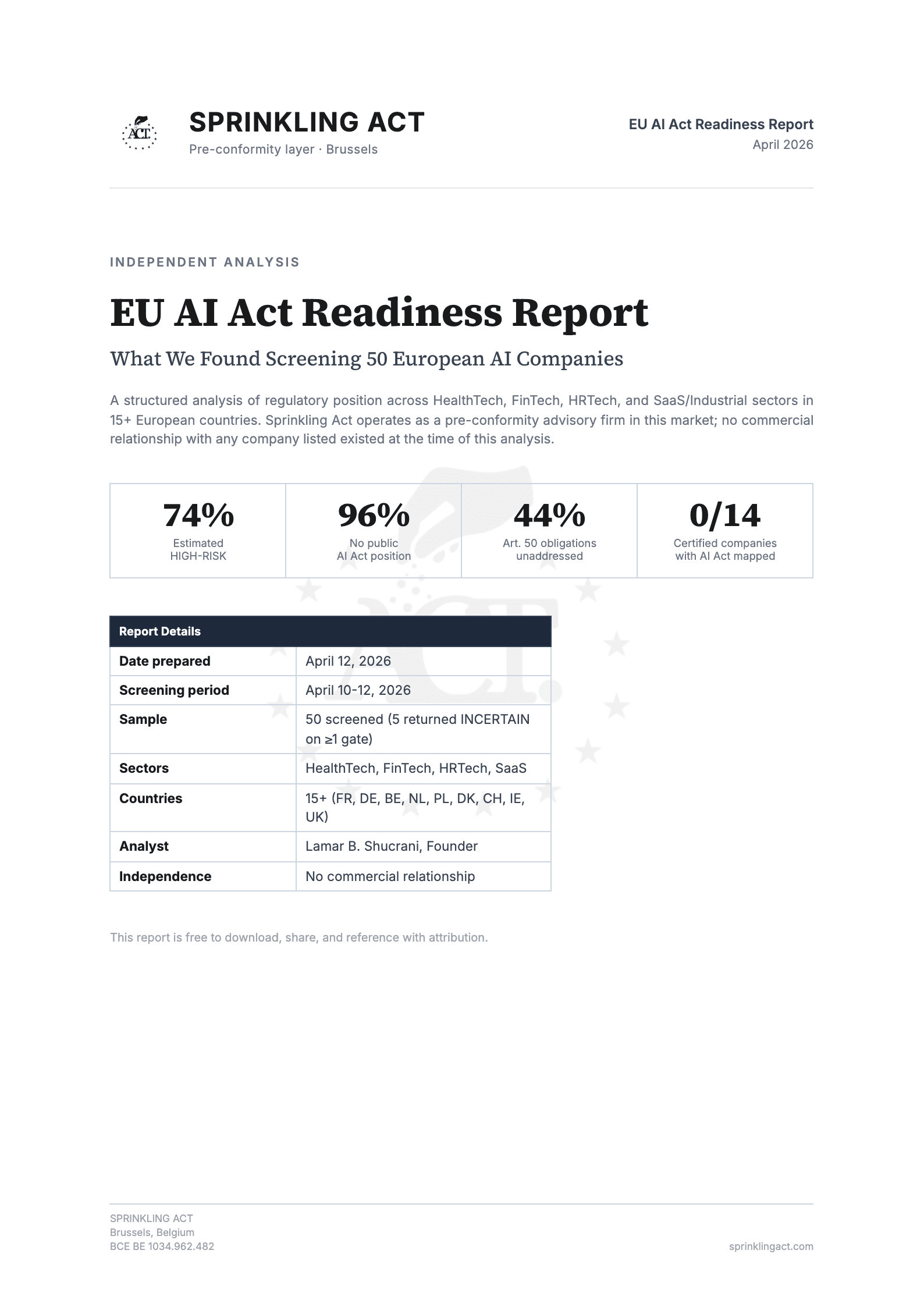
50 companies · 4 sectors · 15+ countries · Screened April 10–12, 2026
11 pages · A4 · 753 KB
HEADLINE
What we found
74% of the 50 companies screened trigger high-risk classification under Art. 6(1) safety components or Art. 6(2) + Annex III use cases. 96% have no public AI Act position. 0 of the 14 companies already holding sectoral certifications (CE MDR, CE-IVD, ACPR banking licences) have publicly mapped the AI Act layer on top.
44% deploy AI systems with direct end-user interaction (chatbots, voice assistants, medical scribes, public-space video analysis) without documented Art. 50 transparency compliance. 34% integrate general-purpose AI models (LLM or foundation models, external or proprietary) within the meaning of Art. 3(63), with no documented obligations under Art. 53 or Art. 50 + Art. 26.
The compliance gap is not about knowledge. The AI Act is covered in trade press and flagged by industry bodies across every sector in this sample. The gap is classification: these companies have not produced a dated, article-mapped document answering the question "what is our regulatory position?". Until that document exists, every other compliance effort is built without a foundation.
METHODOLOGY NOTE
How to read the numbers
The 50 companies were deliberately drawn from four sectors with high regulatory exposure (HealthTech, FinTech, HRTech/EdTech, B2B SaaS/Industrial). The sample is dominated by France (~70%) and is a convenience sample, not a statistical panorama of European AI. The 74% high-risk figure reflects this sectoral selection: in HealthTech and regulated finance, high-risk classification is largely structural under Annex III rather than a discretionary finding.
GPAI is counted per Art. 3(63): LLM/foundation models (external or proprietary), excluding narrow task-specific ML such as credit scoring, medical imaging classifiers, or recommendation engines. All percentages are computed on /50. Five entries returned INCERTAIN on at least one gate and are counted in the base but not in the high-risk total.
All profiles in the report are anonymized. Every evaluation is based exclusively on publicly available information: company websites, product pages, CE mark disclosures, regulatory filings, LinkedIn profiles, press releases. No company was contacted.
What this report is, and is not
This is an independent analysis based on publicly available information, not a legal opinion or a formal audit of any company. Classifications are estimates: only a personalized screening can confirm definitive regulatory status. Sprinkling Act operates as an independent pre-conformity advisory firm in this market; no commercial relationship with any company listed existed at the time of this analysis. Sprinkling Act is not a law firm, not a Notified Body, not a certification body, and not affiliated with the European Commission, the European Parliament, or any national supervisory authority.
PREVIEW
Read the opening pages
The first three pages are shown below: cover, executive summary, findings 1–6, and the sector breakdown. The rest of the report (cases, screening tables, enforcement timeline, full methodology) is in the PDF.
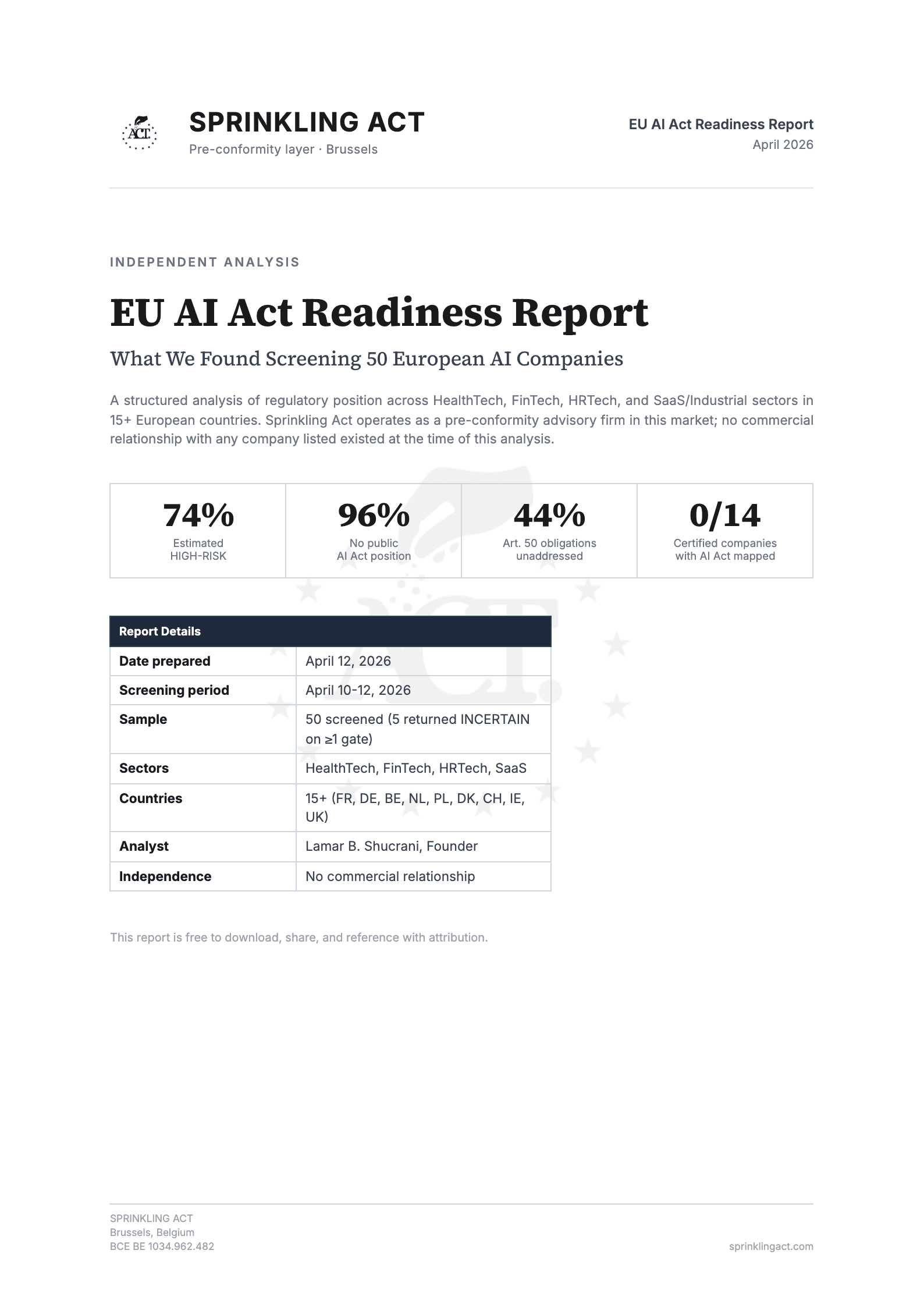
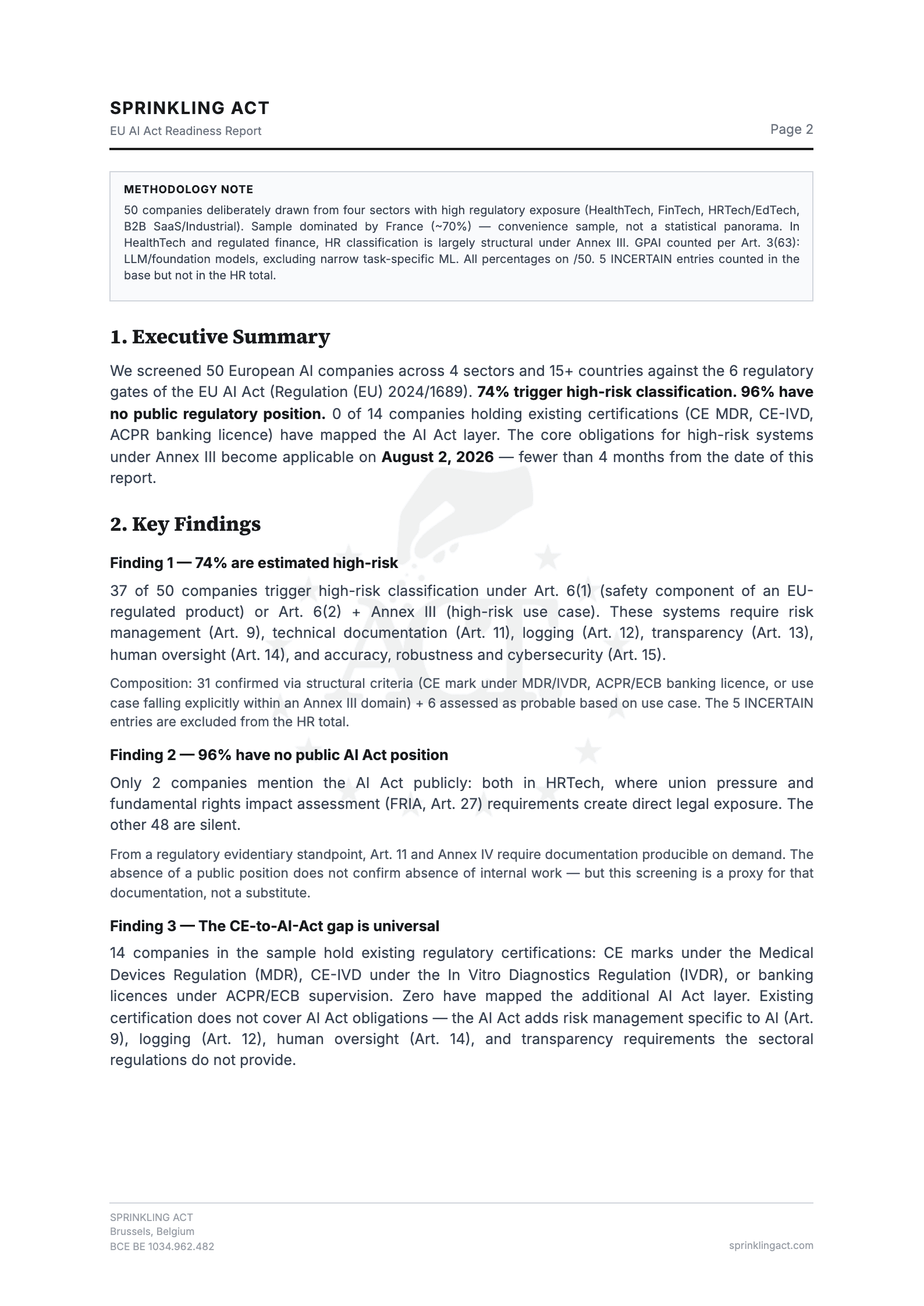
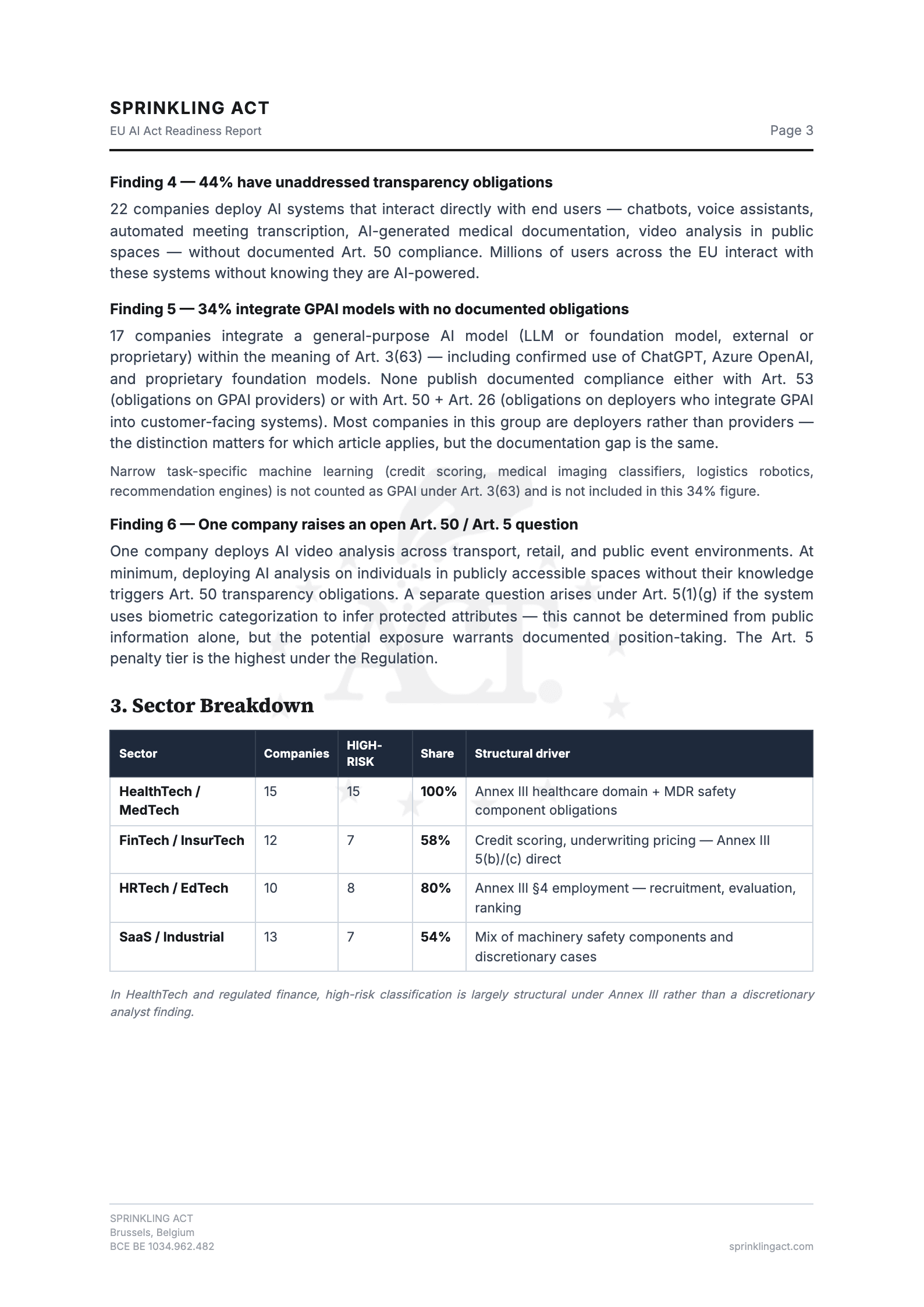
8 more pages inside the PDF
The full report covers nine sections: §1 Executive Summary, §2 Key Findings, §3 Sector Breakdown (incl. §3.1 The Deployer Multiplier, developed in Annex A), §4 Five Critical Cases (anonymised), §5 Aggregate Results, §6 Full Screening Results across 4 sectors and 50 companies, §7 Enforcement Timeline, §8 The Classification Gap (with Art. 99 penalty structure), and §9 Methodology, including the 6-gate framework, sample composition, and limitations.
Or keep reading the closing page below
INDEXED RESEARCH
Verify this report in the public registry
This report is indexed as an official Sprinkling Act research document. You can verify it at any time from the public AI Act registry by looking up the badge code below.
Badge code
SA-REPORT-2026-04
ARCHIVED · CITABLE
Cite this report
This report is archived on Zenodo with a permanent DOI. Use the citation below for any academic, regulatory, or board-level reference.
APA citation
BibTeX
@techreport{shucrani2026euaiact,
  author       = {Shucrani, Lamar B.},
  title        = {EU AI Act Readiness: A Structured Screening of 50 European AI Companies (April 2026)},
  institution  = {Sprinkling Act},
  year         = {2026},
  month        = {April},
  type         = {Independent Research Report},
  doi          = {10.5281/zenodo.19671328},
  url          = {https://doi.org/10.5281/zenodo.19671328}
}Also indexed on SSRN (6652418)
CRYPTOGRAPHIC TIMESTAMP
Independently verifiable date, anchored on Bitcoin
This report is cryptographically timestamped via OpenTimestamps. The timestamp was created on 27 April 2026 and is attested by four independent calendar servers (Eternity Wall, Catallaxy, Alice OpenTimestamps, Bob OpenTimestamps), with the calendar commitments anchored on the Bitcoin blockchain. Anyone can verify the report's integrity and date without contacting Sprinkling Act.
How to verify
- Download the original report PDF below.
- Download the matching .ots proof.
- Install the OpenTimestamps client: pip3 install opentimestamps-client
- Run: ots verify eu-ai-act-readiness-report-april-2026.pdf.ots. The client returns the calendar attestations and Bitcoin block confirmation.
APPLY IT TO YOUR OWN SYSTEM
What is your AI Act position?
This report screened fifty companies. The six-question check does the equivalent for your own deployment: two minutes, no account, nothing sent and nothing stored.
Take the six-question checkUSAGE
This report is free to download, share, and reference with attribution. A permanent URL is provided above. If you cite it in a compliance note, a board deck, or a regulatory discussion, we simply ask that you link back to this page so readers can reach the full document.
SEE ALSO